
Manufacturing integration: combine operations
Combined task restrictions
Combining production order operations is useful when the same item is manufactured in several production orders. You can combine one of the operations into one resource task. The following restrictions apply to combining production operations:
- Combined resource tasks can only be created from a Planned or Firm Planned production order and for the same item.
 Once the production orders are Released, combined operations can be deleted from or added to the combined resource task, provided that no postings have been made yet.
- Operations can only be combined per production order status. You cannot combine an operation from a Planned order with an operation from a Firm Planned order.
- Only one operation per production order can be combined. A production order cannot be included in more than one combined resource task.
- You can only post to a combined resource task when all production orders included in that task have been released.
Creating combined tasks
Combined resource tasks are best handled from the Operations Planning page as shown in the Team Lead role center ribbon.
- From the Team Lead role center, open Operations Planning.
- From the list of operations, highlight the operations to complete (hold down the Ctrl key to select several lines), based on the restrictions above. Sort on any column for an easier overview.
- When selected, use the Combine Operations action in the ribbon to create the combined task. Confirm the prompt to complete this action.
- Use the Required Material action to show the required material for the combined task as per the Routing Link Code. Update material quantities from this page as expected consumption.
- Use the Change Production Order Status action to change the status of the Planned or Firm Planned production order to Released.
- When changing the status from the Production Planning page, all production orders combined in the task change status.
- When the status is changed from the individual production order list, it changes individually. However, posting to the combined task is not possible before all combined production orders are released.
- When one of the production orders with a combined task is selected, the Show Combined Lines action opens a list with all operations in that combination. From this page, modify the combined task: delete lines only when no postings have been made. Only operations with the same criteria can be added:
- Production order status.
- Capacity center type and number.
- Routing link code.
Combined task material allocation and consumption
From the Combined Task Lines page, open Material Consumption to specify and post the actual consumption:
Material Consumption opens the list of components linked to the combined operations through the Routing Link Code.
- With the Item Filter, select one of the components.
- In Actual Consumption Quantity, specify the total component consumption.
- The Actual Consumption Quantity is distributed over the lines, weighted by the original quantity.
- Use Post to post the selected item with the adjusted quantity.
Combined task capacity posting
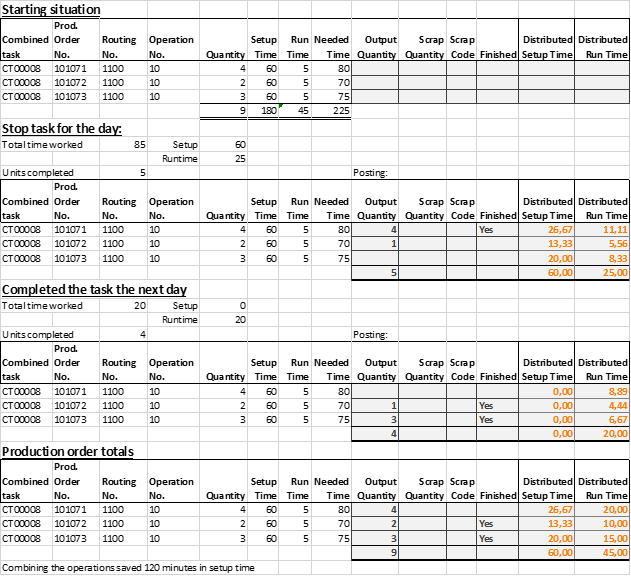
Capacity is posted based on the duration (stop time minus start time) in the time input line, the same as in resource tasks. In a combined task, the time must be distributed to the production orders combined in the task.
An important part of the output posting is the output quantities: how many units have been completed and whether the operation is finished.
The posting algorithm assumes the following:
- Output and scrap quantities, as well as scrap codes, must be specified per production order at posting time.
- Time is distributed over the operations automatically, with the production order quantity as a weight factor.
- Setup and run times are tracked separately based on the assignments to the resource task and the setting on the work or machine center.
- The machine should be stopped when setup is completed to properly record the setup time.
- When the operator does not stop the machine when setup is completed, the time input is stopped and a new time input line is started a new time input line. A runtime assignment is assumed to start immediately following the setup assignment.
The posting example below shows the effects of combined tasks on setup time:
See also
Return to resources integration